The Blnd Edge
Never read a team sheet or analyse form again.
Grounds are empty. Squads turn up after a day’s work. The away end outnumbers the home crowd. And the market hasn’t noticed anything. I found the leagues and the teams where that keeps paying, and I bet every one of them blind.
See every lane and what it’s paid ↓
Trusted by over 300 real punters worldwide1
Not reckless. Blind. There is a difference.
You do not need to look at form, or the table, or know whether they have won a game in five. None of it goes into these bets, and I will show you why in a minute.
Ignore form.
Not because it never worked, but because a machine now does it better than you or I ever could, in the time it takes you to open the app. Which means the homework does not help any more (and I say that as someone who did it every week for years). Worse, it is costing you time and money.
Take the National League North
English football’s sixth tier is where big old clubs land when things go badly wrong. Chester, Southport, Darlington, Macclesfield, Hereford, Morecambe, all of them used to play in top leagues, and every one still carries the crowd it had on the way down. Morecambe, for example, were a League One side three seasons ago and the support came down with them.
So they take hundreds on the road, sometimes over a thousand, to Radcliffe and Marine and Hebburn, towns whose own fans follow United or Liverpool or Newcastle. The away end is now the biggest thing in the ground.
The home advantage effect is mute.
Yet the price has not noticed, since it is built from a league table and a home flag, and neither of those knows who filled the ground. Which leaves a price that is wrong in the same direction, week after week.
So I back the away side. Every time.
34% ROI, and it has paid for twelve months and counting.
No form study found that. Structure did. And it is nowhere near the only one.
The Blind Edge, in money
£2,000 bank · £20 a bet · March 2023 to dateThe same record, month by month
THE PROBLEM
Value betting is dead. Artificial Intelligence killed it.
If value betting has felt like wading through treacle these past couple of years, you are not imagining it, and it is not you getting worse at it.
The big firms run their own AI trading systems now, so a match is repriced in real time on betting pressure, momentum, even a slight change in a team’s formation. They are very good at it, which is rather the point. The slow, lazy price that shrewd punters used to fill their boots with is cut in seconds, not hours (I used to set an alarm for the Tuesday morning lines, which tells you how long ago that was).
And it is not just the bookies. The exchange is so deep on the big leagues that studies find it prices more accurately than the bookies themselves, with six figures matched on a Premier League market without moving it a tick.
So here is the conclusion, and it took me a while to swallow it.
Trying to beat the market on information is a mug’s game.
Because you will not beat an AI model to a form trend, and if your edge depends on spotting something in the stats before the market does, you have not got an edge. You have got a hobby. I had one too, for longer than I care to admit.
So I stopped playing that game.
And then, almost by accident, I found a much better one.
THE EVIDENCE
Three examples of prices that have been wrong for years
A lane is a type of fixture the market keeps pricing the same way, and keeps getting wrong. These three have run for years, through winners, losers and everything in between. Each comes with the reason the price is wrong, and the reason is the whole point.

Why the market gets it wrong
Northern Ireland’s top flight has split in two. Linfield, Larne and Glentoran are full-time now, while everyone else turns up after a day’s work, and so the market has spent four years re-rating the big names upwards. Fair enough, as far as it goes (a full-time squad should beat a part-time one more often than not).
But what it forgets is the ground.
Seventeen hundred people stood close enough to be heard, and they do not care that Glentoran just signed a multi-million-pound sponsorship deal. The market cannot price a group of lads with nothing to lose, in a small league that is still a British top flight. The result is that written-off home sides in this price band have lost less often than they should, for four seasons straight, and that is the bet.

Why the market gets it wrong
A division of part-time clubs, most of them inside the same city and several within twenty minutes of each other. Now think about what home advantage is made of: a hostile crowd, unfamiliar surroundings, a long journey.
Then delete most of it, because the away players slept in their own beds.
Yet the price is still built from the league table and a home flag, so it charges a premium designed for professional football, and it has charged it, unchanged, for three and a half years. Losing three in four is not the flaw (it is a long shot, after all). It is why the price is there.

Why the market gets it wrong
Everyone knows about the altitude, and the prices reflect it heavily. A lowland side travelling up to La Paz is therefore written off, and should be, and the market has that part right.
But the same home premium gets charged when both clubs are altitude clubs.
Then the advantage cancels out, and you have two teams who know how to manage thin air, playing slow, conserving everything, neither able to break the other down. Yet the draw still drifts to a price that assumes someone will win, and better than a third of these finish level against a price that says a quarter should.
WHY IT’S THERE
Nobody in Zacatecas is on Betfair
Twenty years ago you bet on the matches near you. Now you can bet on anything, anywhere, off your sofa at seven in the morning, and if you have a look at a Mexican second-tier market on Tuesday you will see what I mean. Which sounds like progress, right up until you ask who is affecting these prices.
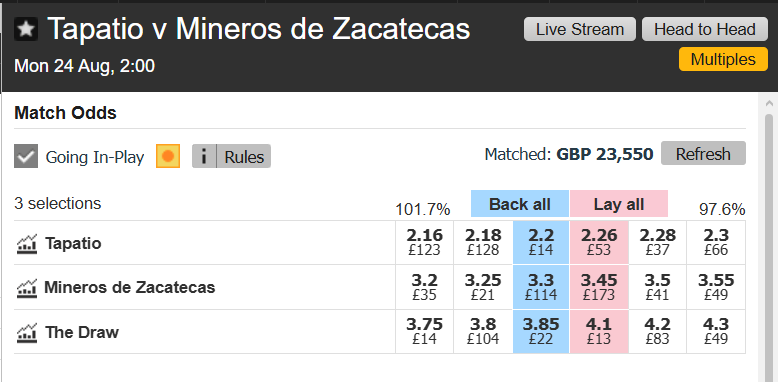
Now ask whose money that is.
Because it is not Mexicans in Zacatecas betting on the above game. They have not got an exchange account, they have a bet at the local bookies (Caliente is Mexico’s Coral). It is semi-professional punters in Manchester and Munich and Rotterdam, working down a fixture list, glancing at a few stats, pricing a game in a city they could not point to on a map.
They do not know which club has not paid its players since May, and they do not know the away side sacked the manager on Thursday, as it never left local radio.
Take the Egyptian Premier League.
On paper it is a big, liquid, well-followed league. On the ground it is something a Cairo taxi driver could explain to you in one sentence, and a British or European punter never hears. Here is the sentence.

What Egyptians know and the market doesn’t
In 2012, seventy-four people died at a match in Port Said, and in 2015 twenty more died in Cairo. The government banned crowds in response, and for most of a decade the biggest clubs in Africa played in front of nobody. Half the league is not a town but an institution anyway (the army, a bank, a petroleum company), sharing the same two or three stadiums.
So “home” in Egypt has meant an empty, borrowed ground for years.
Yet six figures gets matched on the home team in a Cairo derby. The market sees two Egyptian clubs and assumes the home side is stronger, the same way it would in any other league. But the truth is that the games finish level far more often than that price says, and the draw has been the bet since January 2023.
Which is the good news.
Because the minute you stop looking at form and start looking at the structure (the empty grounds, the part-timers, the bus across town) you notice the same mistake has been sitting there for years, sometimes half a decade. And nobody has fixed it, for the simple reason that nobody who sets the price knows it is there.
You do not need to know the league either. You only need to know where the mistake is, and that is a thing you can measure from a spreadsheet in Yorkshire. Which is what the next section is: the measuring.
THE RECORD
The bits other tipsters delete
A qualifier is a match where the price lands inside a lane’s band. Every one since January 2023 is here, flat one unit, nothing removed. Which band, and which filters sit behind it, is the part you pay for.
Month by month
Flat one unit a bet, shown in pounds at £20 a unit. Red months are printed, not hidden.
Backbone & bench, 12 lanes
Ranked by profit. Anything with fewer than twenty live months is greyed out, as there is not enough time on the board to mean much yet, whatever the return says.
Settled at exchange prices net of 2% commission. The names are mine, and members get the league, the outcome, the band and the minimum price.
How it was tested
Four ways a record like this normally turns out to be an illusion. Here is what each one is, and what happened when it was run.
Opens the public record: 5,356 bets, filter by lane, year, win or loss.
Tracked in your dashboard.
The same record sits inside the dashboard as a ledger, one row per lane, with the backtest record on the left, the live figures since June on the right, and every bet underneath when you tap the row. It updates as each bet settles, so you are never guessing how it is going. Here is the screen.
Lanes
40 lanes · 189 live bets settled · +11.7u at 1u flat
The Lanes screen in the members’ area. The Altitude Stalemate is open, showing its last four bets. Core sees Backbone and Bench lanes, and Plus sees every lane and the live column.
That is the whole record. Core is £49 a quarter and Plus is £69, and both are at the bottom of the page whenever you want them.
GOVERNANCE
How I find a profitable lane
Six stages. Most things die at stage two. Nothing gets a penny until it has passed the lot.
Every stage is printed as it happens. Nothing skips the queue, including the lanes I like the look of.
DAY TO DAY
What it looks like every morning
After all that logic, here is the whole job. Five minutes, most days, inside your own members’ dashboard, and there is a picture of it under the steps.
PS. You do not need an exchange account for any of this. Where a qualifier has a proper Betfair market the exchange usually beats the bookies, but for the rest an ordinary bookie account showing the price or better does the job.
Today
Saturday 6 September · 4 qualifiers · 3.0u · £60 · times UK
The members’ area on the day. One card per qualifier, and you tap one to see where the price is and the lane’s record. Lane records are the backtest since January 2023 and are in-sample. Core sees Backbone and Bench, while Plus sees everything, plus the Lanes ledger.
That screen, every morning, is what you are paying for. Core is £49 a quarter, Plus is £69 →
Leaving takes two clicks.
No phone call, no retention offer, no email asking you to reconsider. Your access runs to the end of the quarter you have paid for and then stops, and I do not hold a card on file for anything else.
And the record on this page keeps being published either way, so you can walk away and still watch whether I was right.
JOIN
Two ways in. Both cancel in two clicks.
No trial and no upsell. The record above is what you are buying access to, and the only difference is that members get tomorrow’s before it kicks off.
- Your own members’ dashboard, not an email
- Every Backbone and Bench qualifier, every morning
- The league, the bet, and the price to take
- Each lane’s record beside every tip
- The full public record, every bet since 2023
- Everything in Core
- The Expansion lanes, and the Paper lanes to watch
- Every bookie’s price, ranked, and the exchange price
- The Lane tracker: every lane, every live bet, updated as they settle
BEFORE YOU DECIDE
Six straight answers
What happens after I pay?
You are sent to create your login, with the same email you paid with. That is the only rule, since the email is how your payment and your login are matched. Then you are in your dashboard, and tomorrow’s board is waiting the next morning.
What is the difference between Core and Plus?
Core is the bets: every Backbone and Bench qualifier, with the price to take and the lane’s record beside it. Plus is the bets and the tools: the Expansion and Paper lanes as well, every bookie’s price ranked with the exchange price, and the live Lane tracker. On Core you can see the Plus features, locked, and move up in two clicks.
Can I see the results as they happen?
Yes. The tracker in your dashboard settles every bet as it lands, lane by lane, with the losing months printed next to the winning ones. Core members see the lane records, and Plus members see every live bet behind them. And the public record on this page keeps being published whether you join or not.
Do I need a Betfair account?
No, but it helps. About half the qualifiers have a proper exchange market, and where they do the exchange usually beats the bookies. For the rest, any bookie showing the price or better will do.
How bad does a bad run get?
The record has thirteen losing months in forty-one and a worst drawdown of nineteen units. A losing month is normal, then, and a losing quarter has happened. If you cannot sit through that, this is not for you.
How easy is it to walk away?
Two clicks, no phone call, no retention offer. Your access runs to the end of the quarter you paid for and stops.
Two hard rules, and they matter more than everything above. If your bank is ever down thirty percent from where it started, stop completely and decide calmly, away from a betting app, whether to carry on. And if you ever feel the urge to raise your stake to win back losses, stop betting that day. Chasing is the actual mechanism of gambling harm, and no edge survives it.
Ready to bet blind?
Every lane, every bet, printed whether you join or not. If you would rather keep studying form, no hard feelings, the record stays up either way. Join, and you get tomorrow’s before it kicks off.
Pick Core or Plus ›See every qualifier settled this season →
Notes and sources
- Active subscribers across all services as at August 2026. This is a live count, not a cumulative total of everyone who has ever joined.
- All returns are struck at exchange prices with 5% commission taken off. Where live odds were not archived, the best bookmaker price is estimated from a model, which makes the published figure more conservative rather than less. The FAQ above sets out both estimates in full.
- The sweep covers every league held in the archive with settled results, across every outcome and every price band. A league and band pairing with fewer than eighty settled bets is not eligible to be flagged.
- Months live counts only the months in which a lane actually produced a qualifier. Summer leagues sit idle for half the year, so a calendar span would overstate how long something has been tested.
- NIFL Premiership average attendance of 1,241 for the 2025-26 season, against 1,522 in 2024-25 and 1,589 in 2023-24, published by the Northern Ireland Football League. Ground capacities from published stadium records. League of Ireland attendance figures from league and club reporting.